
OUR TEAM
_edited.jpg)
Founder and President
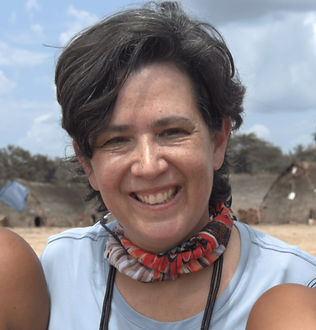
Ceres Scattolini
I am a communication professional and audiovisual director with over 30 years of experience. Throughout that time, I learned that communicating well begins with listening deeply.
In recent years, living alongside the Enawenê-Nawê and the Tenharin, I heard firsthand what the territories demand and understood that my tools could serve something larger. From that listening, Biofílica's first projects were born.
I co-founded the Institute for that reason: to place decades of experience in narrative, communication, and articulation at the service of living territories. What I believe is in everything we build together and what we do always begins with listening.


Vice-President and Founder
Davilson Brasileiro
Indigenist, environmentalist, documentary filmmaker, and intercultural mediator with over 20 years of experience in the Amazon.
His trajectory is defined by the awakening of his own Tupinambá ancestry, a process that transformed his cosmovision and deeply connected him to the wisdom and struggles of indigenous peoples.
He has dedicated decades to listening to and documenting the wisdom of traditional communities, working on the front lines to protect their rights and territories. He collaborates with international outlets such as The Guardian, Die Zeit, and Der Spiegel, using audiovisual storytelling as a tool for cultural safeguarding and social awareness.
"The forest is our true pyramid. My mission is to ensure that the integrity, the way of living well, and the wisdom of its guardians are respected as the very foundation of our future."

Founder
Amanda Scattolini
PhD candidate in Design at PUC-Rio, where she conducts her research at LIDE (Interdisciplinary Laboratory of Design and Education). She holds a Master’s degree in Design from the same institution, supported by a FAPERJ Nota 10 scholarship. She earned a Bachelor’s degree in Visual Arts from Belas Artes de São Paulo and a technical degree in Photography from Escola Panamericana de Artes e Design.
Her research investigates public space as territory, with a focus on placemaking, playful urban furniture for children, and the reinvention of educational spaces in cities, recognizing childhood as a protagonist of the territory it inhabits.
She believes that design and education are tools for territorial regeneration: that listening comes before any project, and that the best solutions already exist within territories, waiting to be co-created with those who live there.

Founder and President
Oloho Enawene
I am a communication professional and audiovisual director with over 30 years of experience. Throughout that time, I learned that communicating well begins with listening deeply.
In recent years, living alongside the Enawenê-Nawê and the Tenharin, I heard firsthand what the territories demand and understood that my tools could serve something larger. From that listening, Biofílica's first projects were born.
I co-founded the Institute for that reason: to place decades of experience in narrative, communication, and articulation at the service of living territories. What I believe is in everything we build together and what we do always begins with listening.